Storm Leftovers to Clear Before Houston's First Cold Front
Summer storms cracked limbs that never came down, and the first strong fall front finishes the job. What to clear in October, and what an arborist checks.
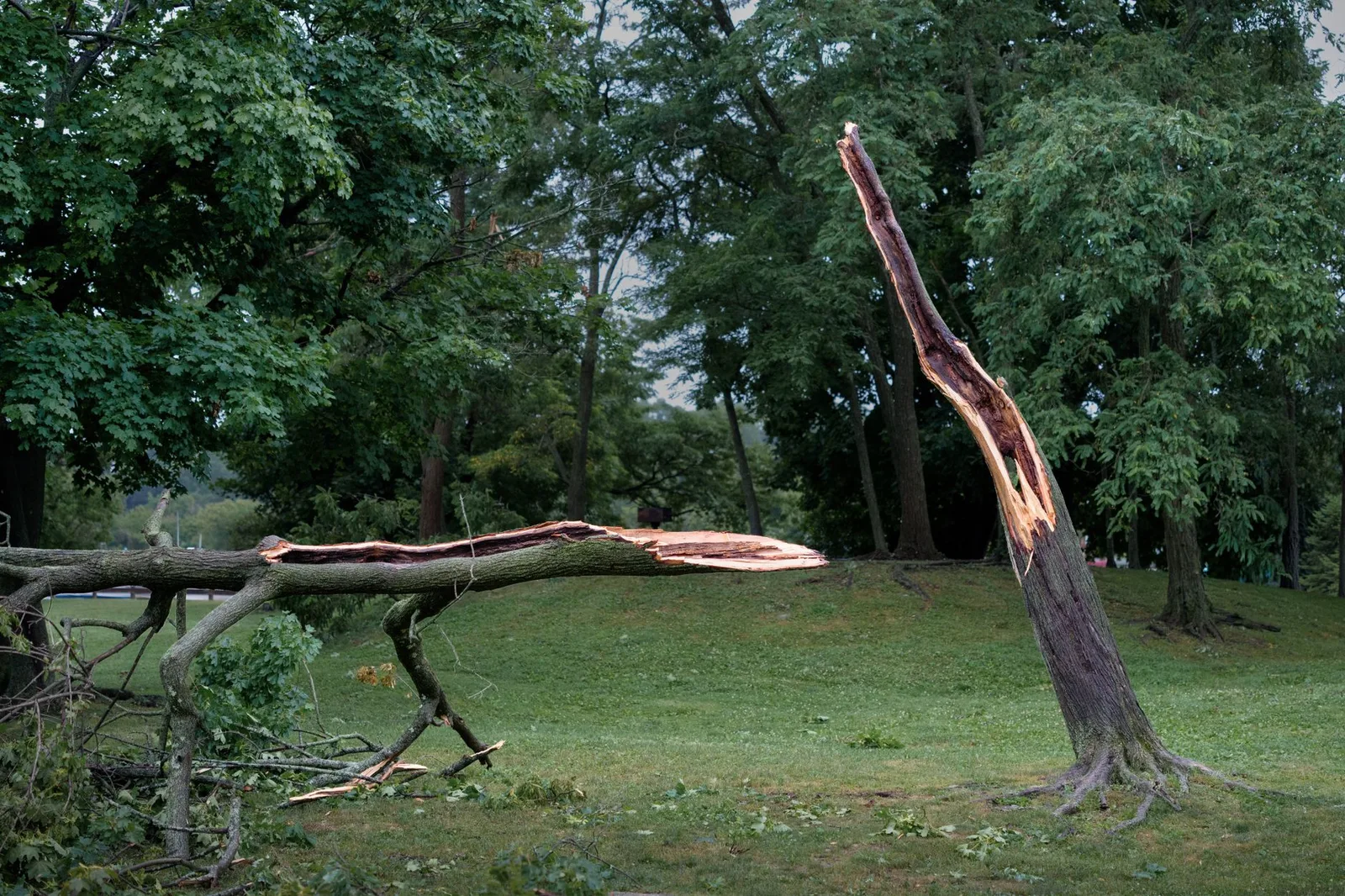
Somewhere in the canopy over your yard there is probably a branch that broke in July and never came down. It cracked at the union, dropped a few feet, and hung up in the limbs below it. From the driveway it looks like part of the tree. It is not. It is a hanger, and a hanger has one job left, which is to finish falling.
Summer storms mostly blow in off the Gulf. The first real cold fronts of the year arrive in October and November, and the wind behind them comes down from the north. A limb that held on through a Gulf storm gets shoved from the other direction by a front. That is the week the phone rings.
October is the month to clear what the summer left behind. Hurricane season is winding down, the oak wilt calendar is wide open, and the trees are still in leaf, which makes the broken parts easy to spot.
What to look for from the ground
Stand back where you can see the whole crown and go tree by tree.
Brown leaves on a green tree. A patch of dead brown leaves in an otherwise green crown in October is a branch that lost its connection months ago. Follow it back to where it attaches and you will usually find the break.
A branch resting on another branch. Hangers rarely fall clean. They wedge. Look for a limb lying across the ones below it at an angle the rest of the tree does not share.
Fresh splits at a fork. Two trunks or two big limbs meeting in a tight V, with a crack opening between them or a dark wet streak running down from the union. The International Society of Arboriculture lists cracks and splits at branch unions among the defects that signal risk. We wrote about which of these forks can be held together in the cabling and bracing guide.
A lean that was not there in May. A tree that shifted in a summer storm and stopped is a tree that moved its roots. Look at the soil on the side away from the lean for a raised crack or a lifted lip of turf. The ISA calls soil heaving one of the warning signs of root failure, especially on a leaning tree.
Anything within reach of a line. A branch already touching the service drop to the house, or hung up in the lines along the street, is not a yard job. The ISA’s standing instruction is never to remove branches from or near power lines, and to call the electricity provider if tree parts are in contact with them.
Why this cleanup does not wait for winter
Dead and broken branches can be cut any month. Texas A&M Forest Service is plain about it: routine removal of weak, diseased or dead branches can be done at any time of year. The oak wilt rule that keeps saws out of oaks from February through June does not apply to October, and it does not apply to dead wood in any month. Every oak cut still gets painted on the spot, which we covered in the oak wilt article.
There is also the matter of who is responsible when it falls. Texas A&M Forest Service puts it in one sentence: if the tree is on your land, you are liable for any loss or damage caused when it falls, and they specifically name failure to remove dead trees near a neighbor’s home. A hanger over the fence line is a conversation you would rather have in October than in January.
What an arborist checks that you cannot see
A walk-around from the ground finds the obvious hangers. It misses the things that turn a simple limb job into a bigger one. When we look at a storm-damaged tree, the checklist runs something like this, and most of it comes straight from the ISA’s tree risk brochure:
- The union, not just the branch. A broken limb tore out of something. Is the wood at the attachment sound, or is there a cavity, soft wood or a fungal conk where the branch used to be?
- Codominant stems. Two equal trunks from one point, with bark pinched between them instead of a solid ridge. These are failure points, and a storm that took one side often cracked the other.
- Mushrooms at the base. Fungal growth on the root flare or on the lawn under the canopy means decay in the roots or lower trunk, and a tree with rotten roots does not need a big wind to go over.
- Poor taper. A long limb with all its weight out at the end, especially one that has been pruned into a tuft of foliage at the tip, is the kind the ISA flags as prone to failure.
- Old topping cuts. A tree that was topped years ago has regrown a crown of weakly attached shoots off rotting stubs. Those shoots are exactly what a front strips out.
- How much crown is left. The Forest Service holds a working limit of no more than a quarter of the crown removed at one time. A tree that lost more than that in a storm, and now needs more cut to make it safe, is a tree we have an honest conversation about.
Any yes on that list moves the job from a cleanup to an assessment. Sometimes the answer is still one cut. Sometimes it is a cable, and sometimes the honest call is that a tree that has already failed once next to the house will do it again.
What to do this month
- Walk the property after the next windy day, not before. The wind does the first inspection for you.
- Photograph anything that looks off, from the same spot each time, so you can tell whether it is moving.
- Keep people and cars out from under a hanger until it is down. A wedged limb gives no notice.
- Do not send anyone up a ladder with a pole saw after a branch that is already cracked. It comes down when it is cut, and it does not care who is under it.
- Get the oaks scheduled now, while the calendar allows it.
If a tree came down or a limb landed on something, the order of operations is different and we laid it out in what to do first after storm damage.
For the standing trees, ask for a free estimate and we will walk the property with you, sort the hangers from the bigger problems, and clear the storm leftovers before the first front does. Our storm cleanup and trimming work covers Houston, Conroe, Magnolia, Tomball, The Woodlands, Spring, Cypress, Kingwood and Humble.
Sources: International Society of Arboriculture, “Recognizing Tree Risk” (2021); Texas A&M Forest Service guidance on pruning mature trees and on liability for hazardous trees.
Tree on your mind? Let's take a look.
Family-owned. Licensed and insured. Owner-supervised. We respond within 24 hours.